CFA Level I formula sheet: the formulas you actually need
About fifty formulas cover most Level I calculations. Here they are by topic, each with a one-line reminder of what it means, so you can rebuild them instead of memorising them.
6 min read / By Gowtham Kumar
No formula sheet is given in the exam, so you must carry these in your head. The good news: most are short, and many follow from a few ideas. Learn what each one says and you will rebuild the ones you forget. This sheet is our own summary, organised by topic.
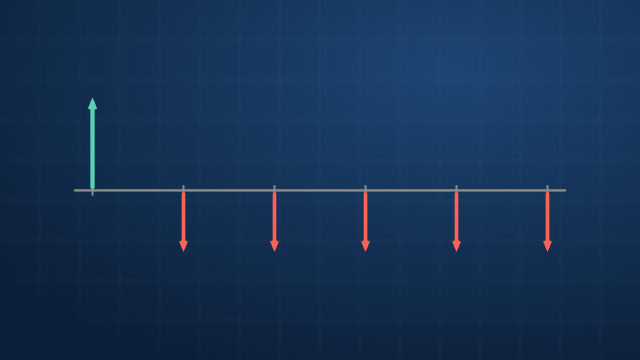
Behind most of these formulas is one idea: a value today is future cash discounted back.
Quantitative methods
Formula
What it says
FV = PV × (1 + r)ⁿ
money grows by compounding
PV = FV ÷ (1 + r)ⁿ
discounting is compounding in reverse
Effective annual rate = (1 + r/m)ᵐ − 1
more frequent compounding, higher effective rate
Continuous compounding: FV = PV × e^(r·t)
the limit of compounding ever more often
Holding-period return = (P₁ − P₀ + D) ÷ P₀
price change plus income, over the start price
Geometric mean = [(1+R₁)(1+R₂)…(1+Rₙ)]^(1/n) − 1
the true compound growth rate
Sample variance = Σ(x − x̄)² ÷ (n − 1)
average squared distance from the mean
Coefficient of variation = σ ÷ mean
risk per unit of return
Covariance → correlation: ρ = Cov(X,Y) ÷ (σₓσᵧ)
correlation is covariance scaled to −1 … +1
z = (x − μ) ÷ σ
how many standard deviations from the mean
Sharpe ratio = (Rₚ − R_f) ÷ σₚ
excess return per unit of total risk
Economics
Formula
What it says
Price elasticity = %ΔQ ÷ %ΔP
how strongly buyers react to price
GDP = C + I + G + (X − M)
spending on everything produced at home
Nominal rate ≈ real rate + expected inflation
the Fisher relation
Real exchange rate = nominal rate (domestic per foreign) × (P_foreign ÷ P_domestic)
currencies adjusted for price levels
MV = PY
quantity theory of money
Financial statement analysis
Formula
What it says
Current ratio = current assets ÷ current liabilities
short-term liquidity
Quick ratio = (cash + short-term investments + receivables) ÷ current liabilities
liquidity without inventory
Inventory turnover = cost of sales ÷ average inventory
how fast stock sells
Days of inventory = 365 ÷ inventory turnover
days goods sit on the shelf
Days of sales outstanding = 365 ÷ receivables turnover
days to collect from customers
Cash conversion cycle = DOH + DSO − DPO
days cash is tied up
ROE = net margin × asset turnover × leverage
the three-step DuPont split
Interest coverage = EBIT ÷ interest expense
how easily interest is paid
Debt-to-equity = total debt ÷ total equity
how much borrowing per unit of equity
FIFO inventory = LIFO inventory + LIFO reserve
converting LIFO to FIFO
Income tax expense = taxes payable + ΔDTL − ΔDTA
deferred tax links accounts and tax
Corporate issuers
Formula
What it says
WACC = wd × kd × (1 − t) + wp × kp + we × ke
average cost of every source of funds
NPV = Σ CFₜ ÷ (1 + r)ᵗ − initial outlay
value created by a project
DOL = %Δ operating income ÷ %Δ sales
operating leverage
DFL = %Δ net income ÷ %Δ operating income
financial leverage
Equity
Formula
What it says
Gordon growth: V₀ = D₁ ÷ (r − g)
value of a dividend growing forever
Justified forward P/E = (D₁/E₁) ÷ (r − g)
payout ratio over (required return − growth)
Sustainable growth g = b × ROE
retained earnings × return on them
Fixed income
Formula
What it says
Price = Σ coupon ÷ (1 + y)ᵗ + face ÷ (1 + y)ⁿ
a bond is a bundle of discounted payments
Current yield = annual coupon ÷ price
income return only
Modified duration = Macaulay duration ÷ (1 + y)
price sensitivity to yield
%ΔPrice ≈ −ModDur × Δy + ½ × Convexity × (Δy)²
duration plus a curvature correction
Money duration = ModDur × full price
price change in money terms
Derivatives
Formula
What it says
Forward price F₀ = S₀ × (1 + r)ᵀ
no-arbitrage price with no income or costs
Put–call parity: S₀ + p₀ = c₀ + X ÷ (1 + r)ᵀ
a protective put equals a fiduciary call
Portfolio management
Formula
What it says
σ²ₚ = w₁²σ₁² + w₂²σ₂² + 2w₁w₂ρσ₁σ₂
diversification lowers risk when ρ < 1
CAPM: E(R) = R_f + β × [E(R_m) − R_f]
return for systematic risk only
β = Cov(R_i, R_m) ÷ σ²_m
sensitivity to the market
Treynor = (Rₚ − R_f) ÷ βₚ
excess return per unit of market risk
Jensen's alpha = Rₚ − [R_f + βₚ(R_m − R_f)]
return above what CAPM predicts
How to remember them
Group them by idea, not by chapter: most valuation formulas are "discount future cash".
Write the sheet from memory once a week and check the gaps.
Understand the units: a ratio of days to turnover, or of risk to return, is half the formula.
No. You must know the formulas. Some questions give inputs you would otherwise derive, but you are never given a sheet.
How many formulas are there in CFA Level I?
Lists from prep providers range from about 100 to over 200, depending on how variations are counted. The ones on this page cover most of what is tested.
What is the best way to memorise CFA formulas?
Understand where each comes from, use them in practice questions daily, and rewrite them from memory regularly. Rote memorising alone fades quickly.