
Home › Free resources
Free, no sign-upFree CFA resources
Tools and lessons you can use today: a study planner that keeps you on schedule, a calculator you can practise on in your browser, formula sheets and the foundations every level builds on.
The CFA study planner (Excel)
Type in your level, start date, exam date and the hours you can give each day. The workbook does the rest:
- A verdict on your plan: comfortable, tight or short, with the buffer in hours.
- Hours per topic, weighted by how much each topic counts in the exam, with a "priority now" score that tells you what to practise next.
- A week-by-week plan in three phases (learn, practise, mocks) with a focus topic and an hours target for every week.
- A daily log that feeds a dashboard: hours done against plan, accuracy, mock scores.
- A habit calendar and streak counter built on a "never zero" daily minimum, plus time-management and discipline rules that work.
Works in Microsoft Excel, Google Sheets (File, Import) and LibreOffice. Levels I, II and III. Free, no sign-up.
Free tools
 Free tool28 min read
BA II Plus calculator guide: every function, on a calculator you can press
The complete guide to the BA II Plus for CFA candidates, built around a working replica of the calculator. Press the keys yourself or press Play and watch every keystroke: settings, clearing, TVM, amortisation, bonds, cash flows, NPV and IRR, statistics, regression and every other worksheet.
Most searched Free tool3 min read
Are you ready for CFA Level I? A 2-minute self-check
Ten honest questions about your time, maths, accounting, English and goals give you a readiness score and a plan for the gaps, before you pay the exam fee.
Most searched Free tool6 min read
CFA Level I formula sheet: the formulas you actually need
About fifty formulas cover most Level I calculations. Here they are by topic, each with a one-line reminder of what it means, so you can rebuild them instead of memorising them.
Tools Free tool4 min read
The best order to study CFA topics at Level I, II and III
Study the topics that others build on first. At Level I that means quant and economics before financial statements, and financial statements before equity and fixed income. Here are tested orders for all three levels, and the reasons behind them.
ToolsFree lessons
All 50 prerequisite concepts are free, each with an animated diagram and a worked example. Start with these:
 Free lesson2 min read
What financial reporting is for
Financial statements exist to help investors and lenders decide whether to provide capital. Everything else in accounting follows from that purpose.
Financial Statement Analysis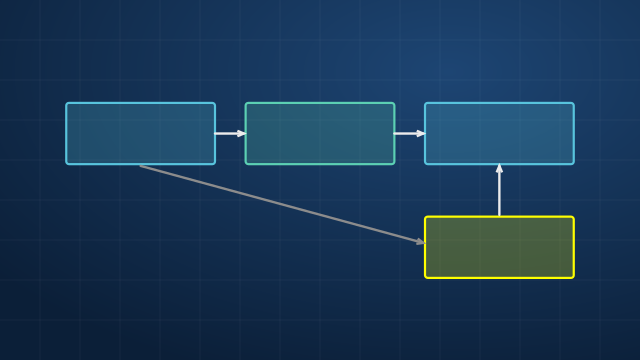 Free lesson2 min read
How the three financial statements connect
The income statement, balance sheet and cash flow statement are three views of one set of transactions. Change one, and the others must move.
Financial Statement Analysis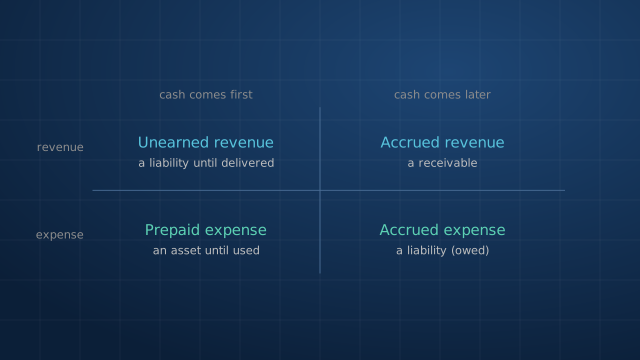 Free lesson2 min read
Accrual accounting: when revenue and expenses count
Revenue is recorded when it is earned and expenses when they are incurred, not when cash moves. The gaps between the two become balance sheet items.
Financial Statement Analysis Free lesson2 min read
Revenue recognition in five steps
Revenue is recognised when a promised good or service is delivered to the customer, at the price allocated to that promise.
Financial Statement Analysis