
Home › How to prepare
Study plans by levelHow to prepare for the CFA exams
A plan for each level, from first reading to exam day. Start with the method that works at every level, then go to your level.
The CFA study planner (Excel)
Type in your level, start date, exam date and the hours you can give each day. The workbook does the rest:
- A verdict on your plan: comfortable, tight or short, with the buffer in hours.
- Hours per topic, weighted by how much each topic counts in the exam, with a "priority now" score that tells you what to practise next.
- A week-by-week plan in three phases (learn, practise, mocks) with a focus topic and an hours target for every week.
- A daily log that feeds a dashboard: hours done against plan, accuracy, mock scores.
- A habit calendar and streak counter built on a "never zero" daily minimum, plus time-management and discipline rules that work.
Works in Microsoft Excel, Google Sheets (File, Import) and LibreOffice. Levels I, II and III. Free, no sign-up.
Start here: every level
The method is the same at every level: a plan you can keep, the right materials, lots of questions and full mock exams at the end.
 Every level3 min read
Are you ready for CFA Level I? A 2-minute self-check
Ten honest questions about your time, maths, accounting, English and goals give you a readiness score and a plan for the gaps, before you pay the exam fee.
Most searched Every level4 min read
Building a 300-hour CFA study plan around a full-time job
Work backwards from exam day, protect the last six weeks for practice, and decide in advance what happens when a week goes wrong.
Strategy Every level4 min read
The best order to study CFA topics at Level I, II and III
Study the topics that others build on first. At Level I that means quant and economics before financial statements, and financial statements before equity and fixed income. Here are tested orders for all three levels, and the reasons behind them.
Tools Every level4 min read
Can you pass the CFA on your own, without coaching?
Yes. Most candidates study on their own around a job. What they need is not a classroom but a plan, enough practice questions, full mock exams and a way to get unstuck.
Tools Every level4 min read
Choosing CFA study materials without wasting money
What the official curriculum gives you, what prep providers add, and how to choose: start from your weakness, not from a brand.
Strategy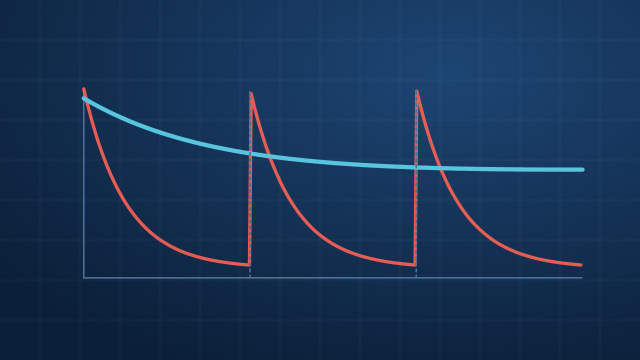 Every level3 min read
Why first principles beats memorising for the CFA exams
Memorised formulas fade between levels and fail under a twist in the question. Ideas rebuilt from their foundations last, and they let you answer questions you have never seen.
StrategyLevel I: breadth and speed
180 multiple-choice questions across ten topics. Cover everything once, then drill questions until the formulas and the calculator are automatic.
 Level I3 min read
CFA Level I: format, topics and weights for 2026 and 2027
Level I tests breadth across ten topics in 180 multiple-choice questions. Here is the format, the topic weights, and what changes for exams from February 2027.
CFA guide Level I4 min read
How to tackle CFA Level I
Level I rewards breadth, speed and accuracy on short questions. Cover every topic, drill the calculator, and practise at 90 seconds a question.
Strategy Level I6 min read
CFA Level I formula sheet: the formulas you actually need
About fifty formulas cover most Level I calculations. Here they are by topic, each with a one-line reminder of what it means, so you can rebuild them instead of memorising them.
Tools Level I28 min read
BA II Plus calculator guide: every function, on a calculator you can press
The complete guide to the BA II Plus for CFA candidates, built around a working replica of the calculator. Press the keys yourself or press Play and watch every keystroke: settings, clearing, TVM, amortisation, bonds, cash flows, NPV and IRR, statistics, regression and every other worksheet.
Most searchedLevel II: valuation in vignettes
Item sets: a long case with four questions. Practise reading the case first, and know the valuation models well enough to apply them, not just recognise them.
 Level II2 min read
CFA Level II: item sets, topics and weights
Level II is valuation, tested through 22 case studies with four questions each. The format, the weights, and why it feels harder than Level I.
CFA guide Level II3 min read
Tackling CFA Level II item sets
Level II questions come four to a case study. Read the questions first, read the vignette for the inputs, and never let one hard set eat the time of three easy ones.
Strategy Level II4 min read
CFA Level I vs Level II vs Level III: how the exams differ
Level I tests whether you know the tools, Level II whether you can value things with them, and Level III whether you can build and defend a portfolio for a real client.
How the exams workLevel III: portfolios and written answers
Half the exam is written. Practise answering in short, exact sentences under time, and choose a pathway that matches your career.
 Level III3 min read
CFA Level III: constructed response, pathways and weights
Level III mixes item sets with written answers, adds a specialised pathway worth a third of the exam, and asks you to synthesise everything for a client.
CFA guide Level III4 min read
Answering CFA Level III constructed-response questions
Graders reward short, specific answers that do exactly what the command word asks. How to read the question, how much to write, and how to get partial credit.
Strategy Level III3 min read
Choosing a CFA Level III pathway
Portfolio Management, Private Markets or Private Wealth: all three lead to the same charter. Choose by the job you want and the material you already use, not by guesses about difficulty.
StrategyThe final weeks
Ethics deserves time at every level; mocks show where you stand; exam day is a skill you can rehearse.
 Every level4 min read
The most challenging CFA topics at each level, and how to beat them
Difficulty is weight times trouble. At Level I the danger is financial statements and fixed income; at Level II, the valuation-heavy vignettes in financial statements, equity and derivatives; at Level III, writing answers for asset allocation, derivatives and your pathway.
Most searched Every level4 min read
How to study CFA ethics
Ethics is 10–15% at every level and often decides close results. Learn the Standards through cases, read every word of the question, and when in doubt, disclose.
Strategy Every level4 min read
Using mock exams and an error log
Mocks are where marks are made. Sit them under exam conditions, then spend longer reviewing than you spent answering, and keep a log of why each mistake happened.
Strategy Every level4 min read
CFA exam day: what to bring and what to expect
Passport, approved calculator, arrive early, and expect strict security. A checklist so nothing on the day costs you marks.
Strategy Every level3 min read
CFA exam results: when they arrive and how to read them
Results come by email five to nine weeks after your exam window closes, as a simple pass or fail plus a score report. The pass mark is never published, so the report is about where you stand, not a number to hit.
How the exams work