Short run: demand shocks change output and prices. Long run: output returns to potential; only the price level changes.
From first principles
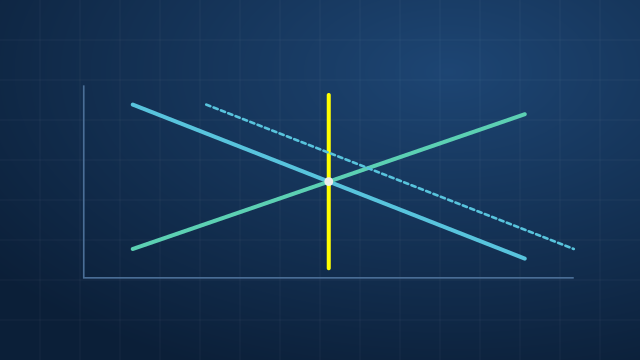
Aggregate demand (AD) slopes down: at a higher price level, real wealth falls, interest rates tend to rise, and exports become less competitive, so total spending on real output falls. It shifts with anything that changes spending at a given price level: confidence, fiscal policy, monetary policy, world growth, exchange rates.
Short-run aggregate supply (SRAS) slopes up: wages and many input prices are sticky, so when output prices rise, producing more is profitable for a while.
Long-run aggregate supply (LRAS) is vertical at potential GDP: once wages and costs fully adjust, the economy's output depends only on labour, capital and technology, not on the price level.
Worked example
Confidence jumps and AD shifts right. Short run: output rises above potential and prices rise: an inflationary gap. Unemployment falls, wages start to rise, SRAS shifts left, and the economy returns to potential output at a higher price level. The reverse (AD falls) opens a recessionary gap.
Supply shocks are harder: a jump in oil prices shifts SRAS left, raising prices while output falls (stagflation), which leaves policymakers no painless option.
Exam traps
- Demand shocks move prices and output in the same direction; supply shocks move them in opposite directions.
- Only shifts in LRAS (more labour, capital or productivity) raise output permanently.
Questions people ask
What shifts aggregate demand?
Changes in household wealth and confidence, business expectations, interest rates, government spending and taxes, the exchange rate and growth abroad.
What causes stagflation?
A drop in short-run aggregate supply, for example an oil price shock. Output falls while prices rise, which leaves central banks with a painful choice.
What is the output gap?
The difference between actual output and the economy's potential. A positive gap means it is running hot and inflation tends to rise; a negative gap means spare capacity and falling inflation pressure.