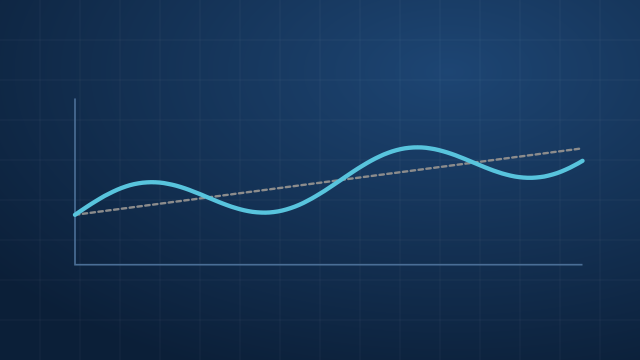
Growth accounting: g(Y) ≈ g(A) + α·g(K) + (1 − α)·g(L).
From first principles
An economy's potential output depends on its inputs and how well it combines them. A production function writes this as Y = A·F(K, L): capital K, labour L, and total factor productivity A, which captures technology and efficiency.
Taking growth rates gives the growth accounting equation: output growth ≈ TFP growth + capital's share × capital growth + labour's share × labour growth.
Two consequences follow:
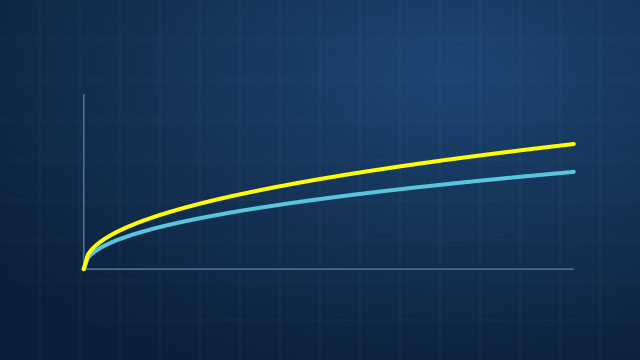
- Capital has diminishing returns. Adding machines per worker raises output per worker by less and less, so investment alone cannot sustain growth in living standards.
- Technology (TFP) shifts the whole curve up, which is the only source of permanent growth in output per worker.
Sustainable growth of potential GDP ≈ growth in labour productivity + growth in the labour force. Other sources include human capital (education and skills), natural resources, and public infrastructure.
Worked example
TFP grows 1%, capital 3%, labour 0.5%, capital's share α = 0.35. Potential growth ≈ 1% + 0.35 × 3% + 0.65 × 0.5% = 1 + 1.05 + 0.325 = 2.4%.
Exam traps
- Investment-led growth fades unless productivity also rises.
- An ageing population (slower labour growth) lowers potential GDP growth unless productivity accelerates.
Questions people ask
What drives long-run economic growth?
More labour, more capital per worker and, above all, better technology and organisation, measured as total factor productivity. Capital alone runs into diminishing returns.
What is growth accounting?
A way of splitting GDP growth into the parts explained by labour, capital and what is left over, which is credited to productivity.
Why does potential growth matter for equity investors?
Over long periods, aggregate corporate earnings cannot grow much faster than the economy. A country's potential growth caps the long-run earnings growth of its market.