Depreciation does not measure loss of value. It allocates a cost over the years that benefit from it.
From first principles
A machine bought for 10,000 helps produce revenue for five years. Expensing the whole 10,000 in year one would make year one look terrible and years two to five look too good. So the cost (less the expected salvage value at the end) is spread over the useful life.
How to spread it depends on how the asset's benefit is consumed:
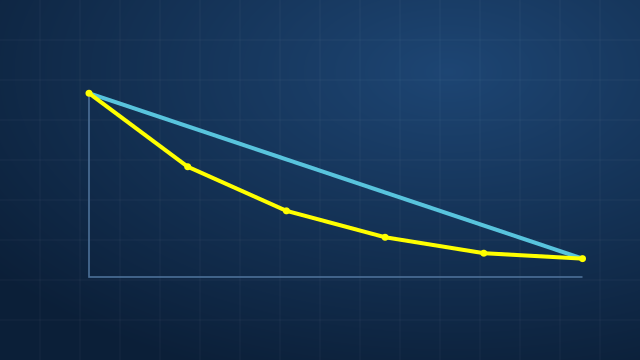
- Straight-line: equal each year, (cost − salvage) / life. Good when the benefit is even.
- Accelerated (double-declining balance): a fixed rate of 2 / life applied to the remaining book value, so early years carry more. Stop when book value reaches salvage. Good when assets are most productive (or most quickly obsolete) when new.
- Units-of-production: in proportion to use. Good for assets that wear out with use.
Try them on the same machine:
Worked example
Cost 10,000, salvage 1,000, 5 years. Straight-line: 1,800 a year. Double-declining at 40%: 4,000, 2,400, 1,440, 864, then 296 to reach 1,000 salvage. Total is 9,000 either way.
Exam traps
- Accelerated depreciation lowers early profit and asset values, raising early asset turnover and lowering early return on assets.
- Cash flow is unaffected (except through tax). Depreciation is added back in the indirect method.
- Changes in estimates (life or salvage) are applied going forward, not restated.
- IFRS requires component depreciation: significant parts with different lives are depreciated separately.
Questions people ask
Which depreciation method gives higher profit?
In the early years, straight-line does, because accelerated methods put more of the cost into the first years. Over the asset's whole life the total expense is the same; only the timing differs.
Does depreciation affect cash flow?
Not directly: no cash leaves when depreciation is booked. It does matter for tax, because tax depreciation lowers the tax bill, and in the indirect cash flow statement it is added back to net income.
What happens when the useful life estimate changes?
The change is applied going forward: the remaining book value is spread over the new remaining life. Past years are not restated. A sudden longer life is a classic way to lift profit.