Monopoly: MR = MC sets the quantity; the demand curve sets the price.
From first principles
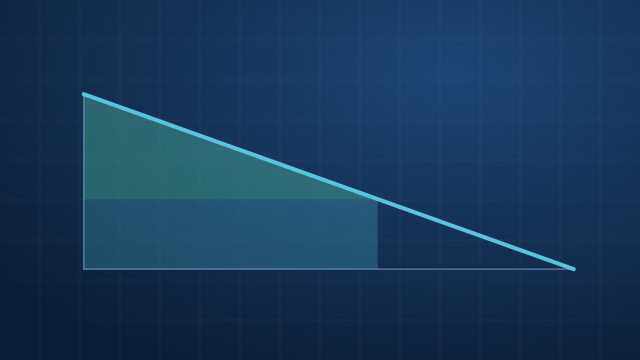
A monopolist is the only seller, so the market demand curve is its demand curve. To sell one more unit it must lower the price, and (without price discrimination) lower it on every unit. So the extra revenue from one more unit is less than its price: MR lies below demand. For a straight-line demand curve, MR falls twice as fast.
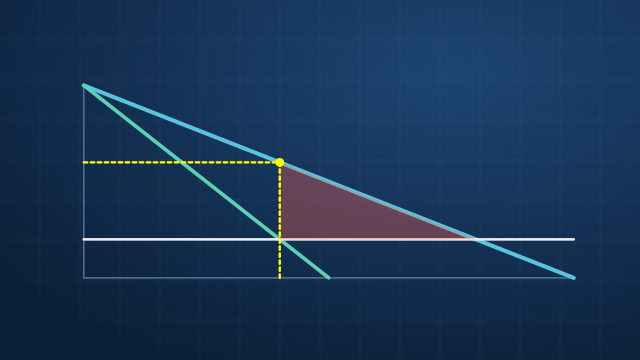
Profit is still maximised where MR = MC. The monopolist chooses that quantity, then reads off the highest price buyers will pay for it from the demand curve.
Compared with perfect competition:
- Quantity is lower and price is higher (price > MC).
- Some buyers who value the good above its marginal cost go without. That lost value is the deadweight loss.
MR is linked to elasticity: MR = P × (1 − 1/|E|). A monopolist never operates on the inelastic part of demand, where MR is negative.
Worked example
Demand P = 100 − Q, so MR = 100 − 2Q. MC = 20. MR = MC → Q = 40, P = 60. A competitive market would produce where P = MC: Q = 80, P = 20. The deadweight loss is the triangle ½ × 40 × 40 = 800.
Exam traps
- Monopolists do not charge "the highest possible price"; they choose the profit-maximising point on demand.
- Natural monopolies (high fixed costs, falling average cost) are often regulated with price caps or rate-of-return rules.
Questions people ask
Why is marginal revenue below price for a monopolist?
To sell one more unit, the monopolist must cut the price on every unit, not just the last one. The extra revenue is the new price minus the loss on all the others.
What is deadweight loss?
The value of trades that would benefit both sides but do not happen because the monopolist restricts output to keep the price high.
What is a natural monopoly?
An industry where one firm can serve the whole market more cheaply than several, because fixed costs are huge, as with water pipes or power grids. These are usually regulated rather than broken up.