Real exchange rate (domestic/foreign) = nominal rate × foreign price level / domestic price level.
From first principles
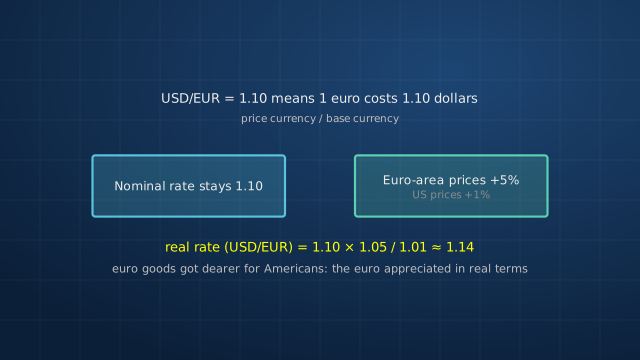
Reading a quote. The convention here is price currency / base currency: USD/EUR = 1.10 means one euro (the base) costs 1.10 dollars. If it rises to 1.15, the euro has appreciated and the dollar has depreciated.
Percentage changes are not symmetric: if USD/EUR rises from 1.10 to 1.15, the euro has appreciated by 4.55%, but the dollar has depreciated by 1.10/1.15 − 1 = −4.35% against the euro.
Why real rates matter. A tourist does not care what a euro costs; they care what a euro buys. The real exchange rate adjusts the nominal rate for each country's price level, measuring the relative price of goods:
real rate (USD/EUR) = nominal rate (USD/EUR) × euro-area price level / US price level
Worked example
The nominal rate stays at 1.10 for a year. Euro-area prices rise 5%; US prices rise 1%. The real rate = 1.10 × 1.05 / 1.01 ≈ 1.14: euro-area goods have become about 4% dearer for Americans, even though the quote never moved.
Exam traps
- Check the base currency before deciding which currency appreciated.
- A higher real exchange rate (domestic/foreign) means the domestic currency buys fewer foreign goods: domestic competitiveness improves.
Questions people ask
How do you read an exchange rate quote?
A quote of EUR/USD 1.10 means one euro costs 1.10 dollars. The first currency is the one being priced; the second is the one you pay with.
What is the real exchange rate?
The nominal rate adjusted for the two countries' price levels. It shows how many foreign goods your domestic goods can buy, which is what matters for trade.
Why can a currency lose competitiveness without moving?
If domestic inflation runs ahead of inflation abroad, the real exchange rate rises even when the nominal rate is flat, making exports dearer.