Marshall–Lerner: a depreciation improves the trade balance if export and import demand are elastic enough.
From first principles
A depreciation makes exports cheaper for foreigners and imports dearer at home. Two views explain whether the trade balance actually improves.
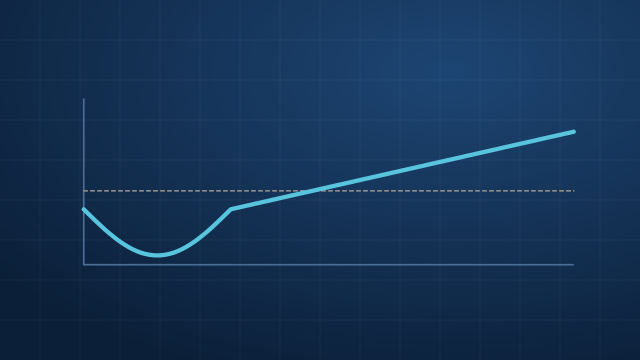
Elasticities approach. It depends on how strongly volumes respond. Import prices rise immediately; volumes adjust slowly. If demand is inelastic, the country pays more for roughly the same imports and the balance worsens. The Marshall–Lerner condition says the trade balance gets better when the export and import demand elasticities are large enough. Starting from balanced trade, that means their sum must exceed 1. Because volumes respond with a lag, the balance often first worsens, then improves: the J-curve.
Absorption approach. From national accounts, the trade balance = national income − domestic spending (absorption). A depreciation improves the trade balance only if income rises relative to spending. If every worker and machine is already busy, income cannot rise much, so spending must fall, for example through tighter fiscal policy. Otherwise the depreciation mainly raises inflation.
Worked example
A country's currency falls 10%. In the first months, import prices rise and volumes barely change, so the deficit widens (the bottom of the J). Over a year, exporters win orders and households switch to domestic goods; if the elasticities satisfy Marshall–Lerner, the deficit shrinks. If the economy is already at capacity and the government keeps spending, absorption does not fall and the improvement is small.
Exam traps
- Marshall–Lerner is about elasticities; the absorption approach is about income and spending. Both are needed for a full answer.
- The J-curve is a timing effect, not a failure of depreciation.
Questions people ask
Does a weaker currency always improve the trade balance?
No. It helps only if export and import volumes respond enough to price. The Marshall–Lerner condition sets the threshold for how responsive they must be.
What is the J-curve?
The pattern where the trade balance first worsens after a depreciation, because import prices rise at once while volumes adjust slowly, and only later improves.
What does the absorption approach add?
A spending view: the trade balance improves only if national income rises relative to domestic spending. With no spare capacity, a depreciation mainly raises prices unless spending is cut.