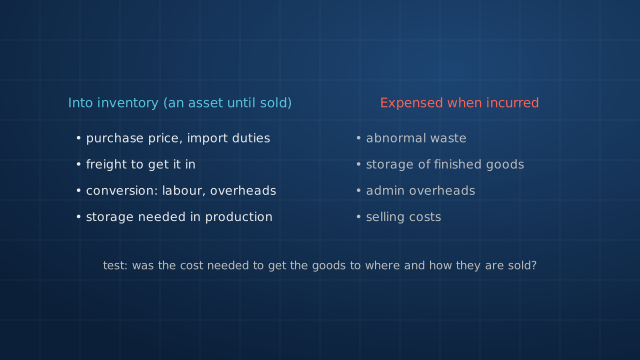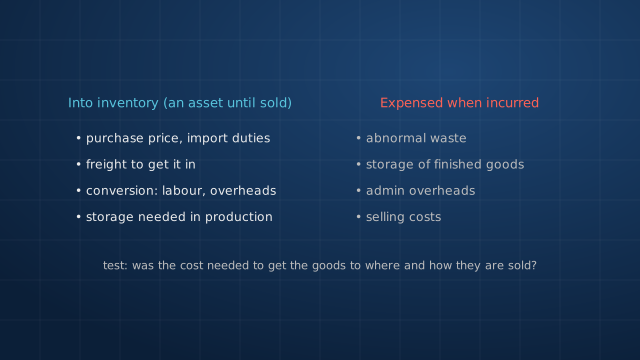
If the cost was needed to make the goods saleable, it waits in inventory until they are sold.
From first principles
Matching again: the cost of goods should be expensed when the goods are sold, as cost of sales. Until then, it sits on the balance sheet as inventory. The question is which costs get that treatment.
Ask one question: did this cost have to be spent to get the goods onto the shelf, ready to sell?
- Included: purchase price, import duties, freight-in, conversion costs (direct labour and allocated production overheads), and storage that is part of the production process.
- Excluded (expensed as incurred): abnormal waste, storage of finished goods, administrative overheads, and selling costs.
Worked example
A furniture maker spends 50,000 on wood, 30,000 on factory wages, 10,000 on factory overheads, 4,000 on wood wasted by a machine fault (abnormal), and 6,000 on showroom staff. Inventory cost = 50,000 + 30,000 + 10,000 = 90,000. The 4,000 of abnormal waste and the 6,000 of selling cost are expenses this period.
Exam traps
- Capitalising more costs into inventory raises profit now and lowers it when the goods are sold.
- Abnormal waste is always expensed, even though it happened in the factory.
- Both IFRS and US GAAP follow the same principle here.
Questions people ask
Which costs are included in inventory?
Purchase price, import duties, freight to bring goods in, and the labour and overheads of turning materials into finished products. In short, whatever had to be spent to make the goods ready to sell.
Which costs are expensed straight away?
Abnormal waste, storage after production (unless it is part of the process, such as ageing wine), general administration and the costs of selling. These do not add to what the goods are worth.
Why does inventory costing affect profit?
Costs placed in inventory wait on the balance sheet until the goods are sold. Putting more costs into inventory raises this period's profit and lowers a later period's.