Money multiplier = 1 / reserve requirement.
From first principles
Money does three jobs: a medium of exchange (no need to barter), a unit of account (prices in one common unit) and a store of value (spend later). Anything that does all three well counts. Today that is mostly bank deposits, not notes and coins.
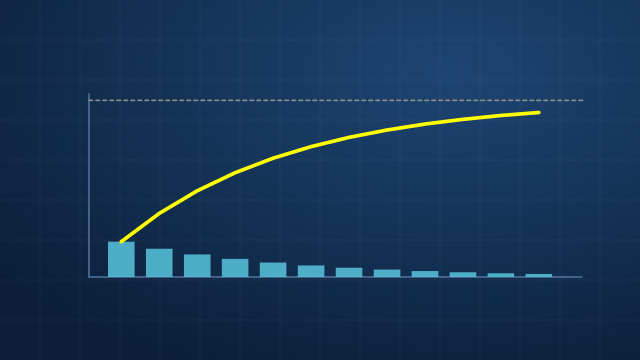
How do deposits multiply? In a fractional reserve system, banks keep only a fraction of deposits as reserves and lend the rest. The loan is spent, and the seller deposits it in another bank, which keeps its fraction and lends the rest again. Each round is smaller, and the series sums to:
Total deposits = initial reserves / reserve requirement.
Try different reserve requirements:
Measuring money
Narrow money (notes, coins and deposits you can spend immediately) and broad money (adding savings and time deposits) have country-specific labels such as M1 and M2. Broad money is the one usually linked to inflation over long periods.
Worked example
A central bank adds 1,000 of reserves; the reserve requirement is 10%. The maximum increase in deposits is 1,000 / 0.10 = 10,000. If people hold some cash, or banks keep extra reserves, the real multiplier is smaller.
Exam traps
- The multiplier is a maximum. Weak loan demand or cautious banks shrink it, as after the 2008 crisis.
- The central bank controls the monetary base, not directly the money supply.
Questions people ask
How do banks create money?
When a bank makes a loan it credits the borrower's account, creating a new deposit. That deposit is spent and lands in another bank, which can lend part of it again.
What is the money multiplier?
In the simple model, total deposits can reach the first deposit divided by the reserve ratio. With a 10% reserve requirement, 100 of new reserves can support up to 1,000 of deposits.
Does the multiplier work like that in practice?
Only roughly. Many central banks no longer set binding reserve requirements, and lending depends more on demand for loans and on capital rules than on reserves.