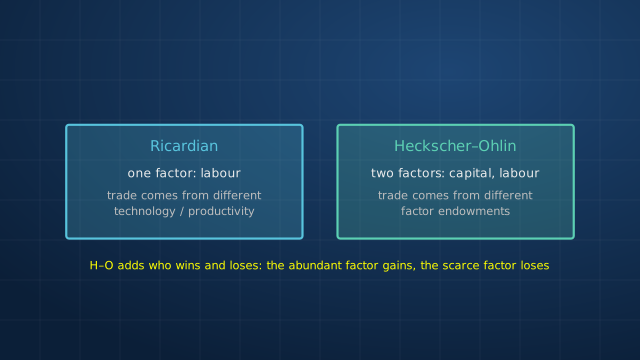
Ricardo: differences in productivity. Heckscher–Ohlin: differences in factor endowments.
From first principles
Comparative advantage says countries should trade. These two models explain why opportunity costs differ in the first place.
Ricardian model. Labour is the only factor of production. Countries differ in technology, the productivity of their labour in each industry. Each exports the good in which its labour is relatively most productive. Gains from trade come from specialisation. Because there is only one factor, the model does not say who inside a country gains or loses.
Heckscher–Ohlin model. Two factors, capital and labour, and the same technology everywhere. Countries differ in how much of each factor they have. A capital-abundant country exports capital-intensive goods; a labour-abundant country exports labour-intensive goods.
Heckscher–Ohlin adds a prediction about income distribution: trade raises the return to a country's abundant factor and lowers the return to its scarce factor. In a capital-rich economy, owners of capital gain from trade and low-skilled workers in import-competing industries can lose.
Worked example
Country A has many machines per worker; country B has many workers per machine. Under Heckscher–Ohlin, A exports machinery and B exports clothing. After trade opens, wages in A's clothing industry face pressure, while B's workers gain.
Exam traps
- Ricardo = technology; Heckscher–Ohlin = factor endowments. The exam often tests which model explains a given scenario.
- Only Heckscher–Ohlin predicts changes in the distribution of income.
Questions people ask
What explains trade in the Ricardian model?
Differences in technology, meaning labour productivity. Each country exports the good where its productivity advantage is largest.
What explains trade in the Heckscher–Ohlin model?
Differences in resources. A country with plenty of capital exports capital-heavy goods; one with plenty of labour exports labour-heavy goods.
Who wins and loses under Heckscher–Ohlin?
The owners of the abundant resource gain and the owners of the scarce resource lose, which helps explain why trade can hurt low-skilled workers in rich countries.