Trade by opportunity cost, not absolute productivity.
From first principles
Absolute advantage means producing a good with fewer resources. Comparative advantage means producing it at a lower opportunity cost: giving up less of other goods.
The surprising part: even a country that is better at producing everything gains from trading, provided the two countries give up different amounts of one good to make the other.
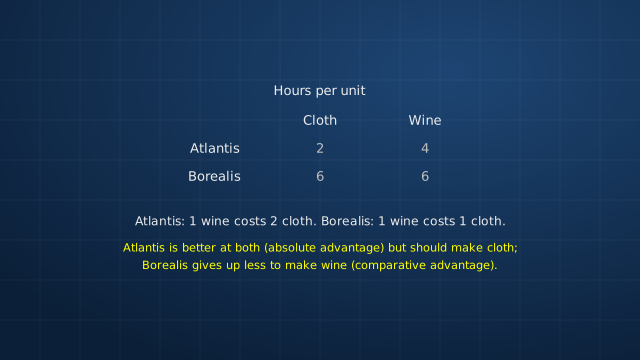
In the example, Atlantis needs 2 hours for cloth and 4 for wine; Borealis needs 6 for each. Atlantis is better at both. But:
- For Atlantis, 1 wine costs 2 cloth (4 hours / 2 hours).
- For Borealis, 1 wine costs 1 cloth.
Borealis gives up less to make wine, so it has the comparative advantage in wine; Atlantis has it in cloth. At any trade price between 1 and 2 cloth per wine, both countries can consume more than they could alone.
Worked example
Each country has 120 hours. Without trade, splitting the hours equally, Atlantis makes 30 cloth and 15 wine, and Borealis 10 cloth and 10 wine.
With specialisation, Borealis makes only wine (20 units), and Atlantis makes 50 cloth and 5 wine. World output rises from 40 cloth and 25 wine to 50 cloth and 25 wine: the same wine plus 10 extra cloth.
They trade 10 wine for 15 cloth (1.5 cloth per wine, between the two opportunity costs). Atlantis ends with 35 cloth and 15 wine; Borealis with 15 cloth and 10 wine. Each has 5 more cloth and the same wine as before trade.
Exam traps
- Comparative advantage is relative; a country always has a comparative advantage in something.
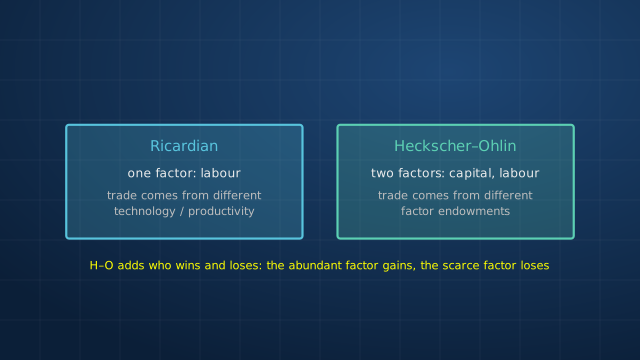
- Gains are not shared evenly within countries: the industries that shrink lose, even if the country gains overall.
Questions people ask
What is the difference between absolute and comparative advantage?
Absolute advantage means producing more with the same inputs. Comparative advantage means giving up less of other goods to produce something. Trade follows comparative advantage.
Can a country gain from trade if it is worse at everything?
Yes. As long as its opportunity costs differ from its partner's, both can specialise in what they give up least to make, trade, and end up with more of both goods.
Who loses from trade?
Workers and owners in industries that shrink when imports arrive. The country gains overall, but the losses are concentrated, which is why trade policy is contentious.