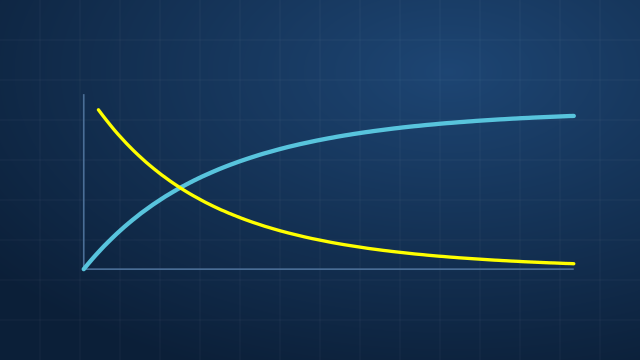
Elasticity = % change in quantity / % change in price. Above 1 (in absolute value), buyers react strongly.
From first principles
When a price rises, people buy less. The question for a seller is how much less. If quantity falls by a larger percentage than price rises, revenue falls; if by a smaller percentage, revenue rises.
That ratio of percentages is the price elasticity of demand. It is negative (price and quantity move in opposite directions), so we usually talk about its absolute value:
- |E| > 1: elastic. Buyers are sensitive. A price cut raises revenue.
- |E| < 1: inelastic. Buyers barely react. A price rise raises revenue.
- |E| = 1: unit elastic. Revenue is at its maximum.
On a straight-line demand curve, elasticity is not constant: high at high prices (where a 1-unit price change is a small percentage), low at low prices. Drag the price:
What makes demand elastic
Close substitutes, a large share of the budget, a long time to adjust, and a narrowly defined good (one brand of coffee rather than coffee in general) all make demand more elastic.
Worked example
Demand Q = 100 − P. At P = 70, Q = 30, elasticity = (dQ/dP) × P/Q = −1 × 70/30 = −2.33: elastic, so cutting the price to 65 raises revenue from 2,100 to 2,275.
Exam traps
- Slope is not elasticity. A straight line has one slope but every elasticity from zero to infinity.
- Perfectly inelastic demand is a vertical line (quantity never changes); perfectly elastic is horizontal.
- Revenue is maximised where elasticity = −1, which is the midpoint of a straight-line demand curve.
Questions people ask
What does a price elasticity of −2 mean?
A 1% rise in price cuts the quantity bought by about 2%. Because quantity falls faster than price rises, total spending on the good falls: demand is elastic.
Why does elasticity change along a straight demand line?
Elasticity compares percentage changes. High up the line, price is large and quantity small, so a small quantity change is a big percentage. Lower down the opposite holds, so the same line moves from elastic to inelastic.
What makes demand more elastic?
Close substitutes, a large share of the budget, time to adjust and a narrowly defined product. Petrol in general is inelastic; one brand of petrol at one station is very elastic.
How do firms use price elasticity?
To decide whether a price change will raise or lower revenue. Raising price on an inelastic product raises revenue; on an elastic product it loses customers faster than it gains margin.