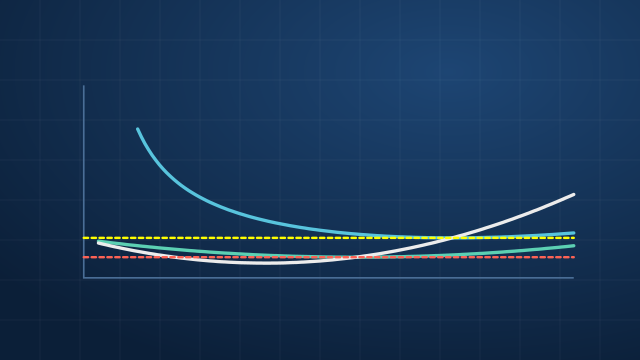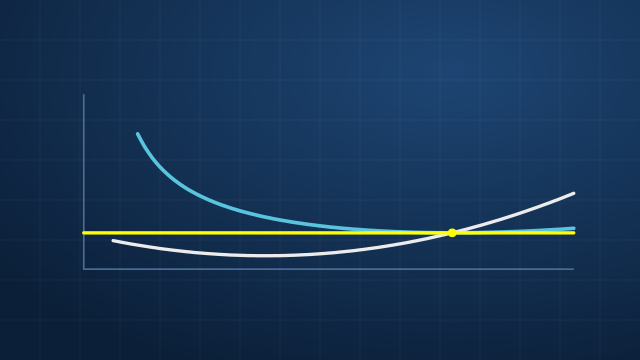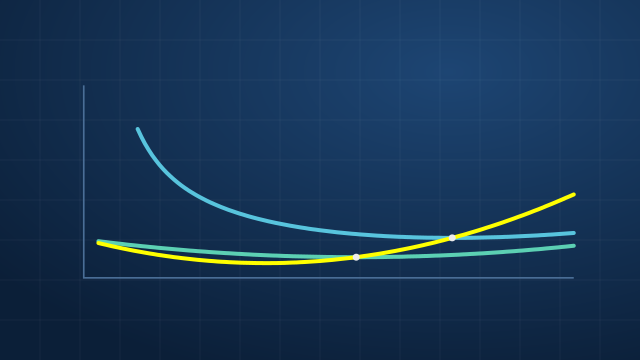
MC = ΔTC / ΔQ. Marginal cost cuts average variable and average total cost at their minimum points.
From first principles
In the short run some costs are fixed (rent, the factory) and do not change with output; others are variable (materials, hourly labour). Total cost = fixed cost + variable cost.
Spread over output:
- AFC (average fixed cost) = FC / Q falls forever, as fixed costs spread over more units.
- AVC (average variable cost) = VC / Q, and ATC = AFC + AVC.
- MC (marginal cost): the cost of the next unit. Because of diminishing marginal returns, MC eventually rises.
Why does MC cut AVC and ATC at their lowest points? Think of grades: if your next exam scores below your average, the average falls; above, it rises. Average cost bottoms out exactly where the marginal unit costs the same as the average.
Worked example
FC = 100. Producing 10 units has VC 200; 11 units has VC 225. MC of the 11th unit = 25. ATC at 10 units = 30; at 11 = 325 / 11 = 29.5. Because MC (25) is below ATC (30), ATC falls.
Exam traps
- Fixed costs do not affect MC, so they do not affect the short-run output decision; they only affect whether the firm makes a profit.
- The gap between ATC and AVC is AFC, which shrinks as output grows.
Questions people ask
Why is the average total cost curve U-shaped?
At low output, fixed costs spread over more units pull average cost down. At higher output, diminishing returns push marginal cost up, and once it exceeds average cost it drags the average up.
Why does marginal cost cut average cost at its lowest point?
If the next unit costs less than the average, the average falls; if it costs more, the average rises. So the average is lowest exactly where the two are equal.
What is the difference between fixed and sunk costs?
Fixed costs do not change with output in the short run but can still be avoided by closing. Sunk costs are already spent and cannot be recovered, so they should not affect any decision.